
When your baby starts solids, every spoon feels important.
You read labels.
You question ingredients.
You second-guess family advice.
And one of the biggest questions parents face during weaning is this:
“Does my baby really need salt?”
The short answer, according to pediatric health authorities across the world, is no.
In fact, babies under one year should not have added salt in their food. And there are strong biological and developmental reasons behind this advice.
Let’s break it down clearly — and then understand why Dino Dine’s salt-free khichdi range for 9–12 months aligns perfectly with what science recommends.
This isn’t about making baby food bland.
It’s about understanding how a baby’s body works in the first year of life.
A baby’s kidneys are not miniature adult kidneys.
In the first year of life, kidney function is still maturing. The systems that regulate sodium and fluid balance are developing rapidly. That means babies have a much narrower safety margin when it comes to processing excess sodium.
When a baby consumes too much salt:
Health authorities simplify this into a practical guideline: avoid adding salt to baby food before age one.
For babies under one, even small amounts of salt can quickly approach or exceed their recommended daily limit.
2.A Baby’s Daily Salt “Budget” Is Extremely Small
Most parents don’t realise how tiny the daily allowance actually is.
For babies under one year:
That is very little.
Now imagine:
Suddenly, that small daily limit is crossed — without anyone intending to overdo it.
This is why “no added salt” is not a trend.
It’s a protective measure.
3.Taste Preferences Are Built Early
Babies are not born craving salt.
Taste preferences are shaped through exposure.
When babies are introduced to salty foods early:
Early feeding is not just about nutrients.
It is about training the palate.
When babies experience the natural savoury taste of:
They learn to enjoy real food — not just salt-enhanced flavour.
That foundation can influence food choices later in childhood.
4.Research on Early Sodium Intake
Research has shown that lowering sodium intake in early infancy can produce small but measurable reductions in blood pressure.
Some long-term follow-ups even suggest that early sodium exposure may influence blood pressure later in childhood.
While science continues to evolve, the message from pediatric guidance remains consistent:
There is no nutritional need to add salt to baby food under one year — and moderation in early life supports long-term health patterns.
Many parents worry:
“If salt is essential, won’t my baby become deficient?”
The answer is no.
Sodium is naturally present in:
Babies receive the sodium they need through these sources. There is no requirement to add extra salt during the first year.
The real challenge today isn’t home-cooked baby food.
It’s:
Snack-style baby foods, especially savoury ones, can sometimes contain surprisingly high salt levels.
Because a baby’s daily allowance is so small, these foods can quickly use up the entire “salt budget” for the day.
That’s why choosing deliberately salt-free meal options makes feeding simpler and safer.
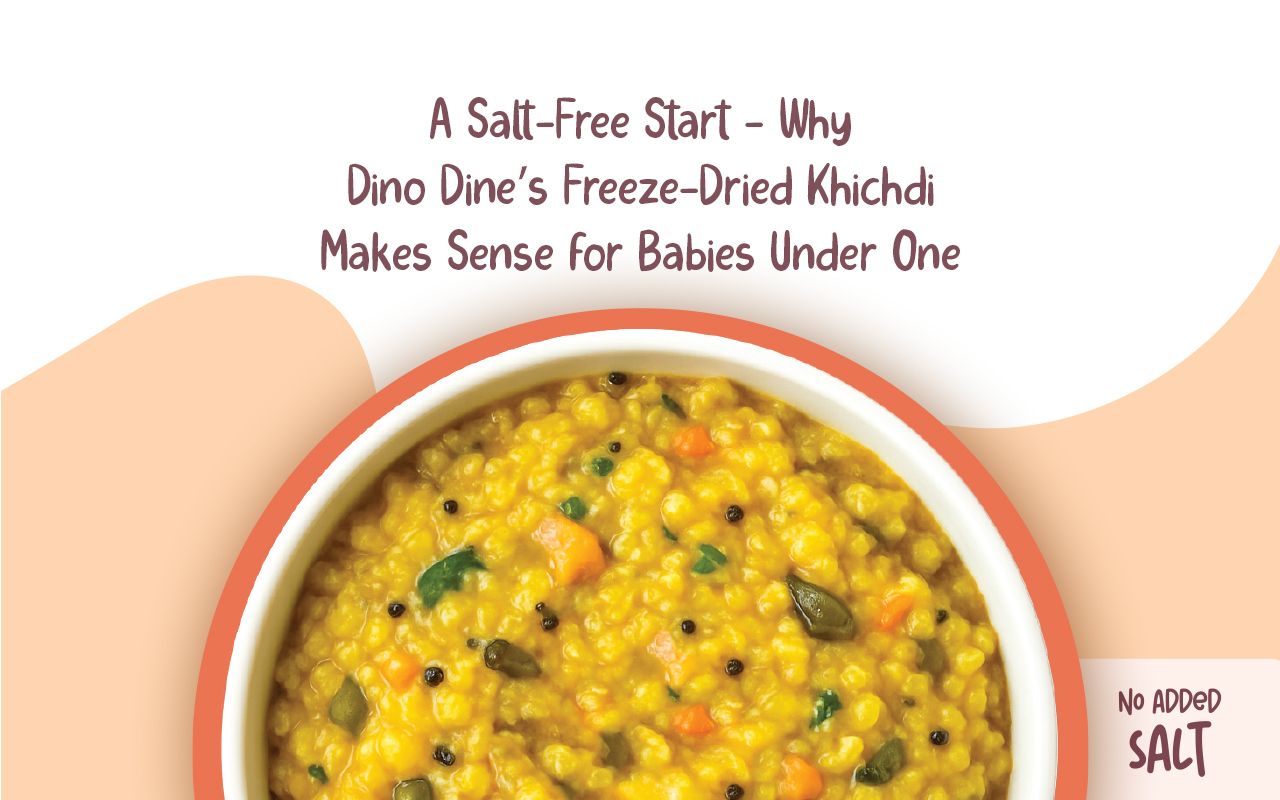
At Dino Dine, the nine-to-twelve-month khichdi range is intentionally designed with no added salt.
This isn’t a marketing angle.
It’s alignment with mainstream pediatric guidance.
When you choose Dino Dine khichdi for your baby under one:
It removes one of the easiest feeding mistakes to make.
Yes — it comes in a packet.
But what matters is how it is preserved.
Dino Dine uses freeze-drying, a gentle preservation method that removes water at low temperatures under vacuum. Unlike high-heat drying, freeze-drying can help retain structure, flavour, and many nutrients.
Because water is removed, the meal becomes shelf-stable without relying on salt as a preservative.
That means:
Just real khichdi — preserved smartly.
Add hot water.
Let it rest.
Serve.
Let’s be honest.
We all aim to cook fresh, salt-free meals every day.
But then:
In those moments, having a salt-free meal ready matters.
Dino Dine acts like a safety net — especially during the 9–12 month stage, when babies are exploring flavours but still need protection from excess sodium.
After the first birthday, small amounts of salt can gradually be introduced through normal family meals — still in moderation.
But the first year is about setting the foundation.
A salt-free start:
Feeding your baby isn’t just about filling a bowl.
Dino Dine’s salt-free khichdi for babies under one is designed around that philosophy.
Because sometimes the smartest choice in baby nutrition is not what you add but what you choose to leave out.